Gateway Review Evidence Pack: What Reviewers Check
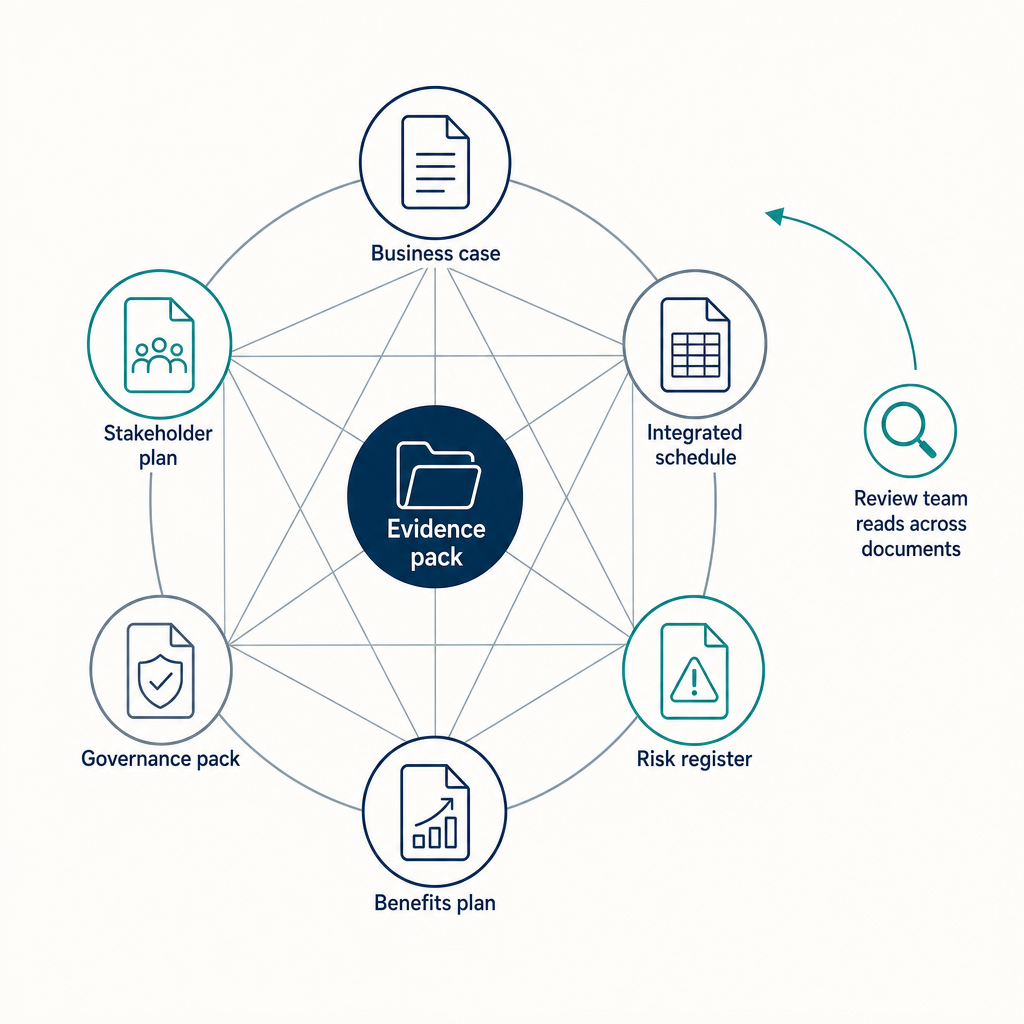
A gateway review evidence pack is the set of documents an independent review team reads to judge how confident it is that your project will be delivered, and, at an investment-decision gate, it usually spans the business case, the integrated schedule, the risk register, the benefits realisation plan, the governance pack and the stakeholder material. The single most important thing to understand is this: reviewers do not read those documents one at a time. They read them against each other, looking for the places where they disagree.
If you are the senior responsible owner (SRO), programme director or PMO lead assembling the pack for a gate, this guide sets out what goes in it, what each document is for, and, most usefully, what reviewers actually check when they read across the pack. If you want the wider context first, start with our guide to the gateway review process, then come back here to build the pack.
What is a gateway review evidence pack?
The evidence pack is the documentation you hand to the review team before review week so they can examine it, interview the right people and form an independent view. In the Western Australian process, for example, a team of three to four experienced, independent reviewers examine project documents, interview stakeholders and prepare a confidential report for the SRO over three to five days. The pack is what they examine.
There is no single mandated list that fits every project. The exact contents depend on which gate you are at and whose gateway system you are in, the Commonwealth, a state jurisdiction, or your own organisation's stage-gate. So treat the list below as the typical shape of an investment-decision pack, and always confirm the specifics against the workbook for your gate.
What goes in the pack, document by document
For an investment-decision gate (the point where the full business case and governance are confirmed before money is committed), a pack commonly contains the following. The right-hand column is the more useful one: it is what reviewers look for when they cross-check that document against the rest of the pack.
| Document | What it is | What reviewers check across the pack |
|---|---|---|
| Business case | The core justification, the problem, the options, the recommended option, costs, benefits and value for money. | That it is internally consistent and still current: the costs, dates and scope in the business case match the schedule, the cost plan and the benefits plan. |
| Integrated schedule | The end-to-end timeline showing the critical path, key milestones and dependencies. | That milestone dates agree with the business case and the funding profile, and that the critical path is credible rather than aspirational. |
| Risk register | The live list of risks and issues with owners, ratings and mitigations. | That the big risks are reflected elsewhere, in schedule contingency, in the cost estimate and in the governance decisions, not quarantined in a spreadsheet. |
| Benefits realisation plan | The benefits the project exists to deliver, with measures and targets. | That every benefit has an owner, a baseline, a measure and a funded milestone, and that the benefits still match the case being made. |
| Governance pack | The decision-making structure: the SRO appointment, the board, the RACI, delegations and reporting lines. | That accountability is clear and current, and that the people named are the people actually making decisions. |
| Stakeholder engagement plan | Who is affected, how they are being engaged, and where support or resistance sits. | That the plan is realistic given the schedule and that known objections appear in the risk register rather than being absent. |
| Commercial / procurement strategy | The sourcing approach, market position and (near a tender decision) the recommended supplier. | That the approach is consistent with the schedule and the assumptions in the business case, and that probity is evidenced where a decision is imminent. |
Smaller supporting artefacts often sit alongside these, a cost plan or financial model, a quality or assurance plan, and the risk-potential assessment you completed with the gateway unit. The business case is the anchor: Infrastructure NSW describes it as the key document that justifies the project scope and investment, and everything else in the pack should support the story it tells.
How reviewers actually read the pack
This is where most packs are won or lost. Reviewers are not marking each document in isolation; they are testing whether the pack tells one coherent story. The UK Infrastructure and Projects Authority's investment-decision workbook makes this explicit, one of the things the review team tests is that there is consistency between the cases of the business case. The same instinct runs through every jurisdiction's process: an independent team's job is to find the gaps and contradictions the project team has stopped seeing.
In practice, the challenges almost always come from claims that disagree between documents. A few patterns recur:
- The dates don't line up. The business case assumes a contract award in September; the integrated schedule shows November. One of them is wrong, and the reviewer will ask which.
- The numbers don't reconcile. The headline cost in the business case is not the number in the cost plan or the financial model, or the funding profile can't actually pay for the schedule.
- The benefits float free. A benefit is claimed in the business case but has no owner, no measure or no milestone in the benefits plan, so no one can say how it will be delivered or tracked.
- The risks are invisible elsewhere. A high risk is rated red in the register but there is no matching contingency in the schedule or cost estimate, and the board minutes never mention it.
- Governance is out of date. The RACI names people who have moved on, or the SRO appointment isn't documented.
None of these is a technical failure. Each is simply the pack contradicting itself, and each is exactly the kind of thing you can find and fix yourself before the review team does.
What good evidence looks like
Volume is not the goal. A large pack that a reviewer has to excavate is weaker than a lean one they can navigate. Good evidence tends to share four qualities:
- Navigable. A reviewer can find the answer to each criterion quickly, ideally via a short index that maps each criterion to the document and page that answers it.
- Criteria-mapped. The pack answers the published criteria for your gate, not a generic set. Each gateway unit issues a workbook that sets out what the review will probe.
- Consistent. Cost, schedule and scope tell one story across every document, and any baseline change is minuted and carried through the pack.
- Current and owned. Documents are the live versions, dated, with a named owner, not last quarter's draft copied forward.
For a step-by-step way to get there, our gateway review checklist walks through the consistency checks in order, from confirming your gate to reconciling the documents before freeze.
The pack changes by gate and jurisdiction
What belongs in the pack shifts as the project matures. An early business-justification gate leans on the strategic case and options; an investment-decision gate turns on the full business case and governance; a readiness-for-service gate is about transition, testing and operational handover. The gate you are at sets the criteria, so the pack follows.
Jurisdiction matters too. The Australian Government process is set out in the Department of Finance's Resource Management Guide 106 (RMG 106), while states run their own systems and thresholds, for example Victoria's Department of Treasury and Finance, Queensland Treasury and the New Zealand Treasury. The core documents are broadly the same; the exact list, templates and thresholds are not. Always build from the workbook for your specific gate and unit rather than a generic list.
Why this matters for your rating
A gateway review does not pass or fail your project, and it cannot stop it, but the delivery-confidence rating it produces travels upward to the people who fund and oversee your work. A pack that contradicts itself invites an Amber or Red, because reviewers cannot give confidence to a story that doesn't hold together. The good news is that the contradictions are findable in advance. Reading your own pack the way a reviewer will, across documents, against the criteria, is the highest-value hour you can spend before review week.
How Assay helps
This cross-document read is exactly what Assay does. For a fixed $2,500, within 48 hours of an accepted pack we return the missing evidence, the contradictions between documents, the criteria that are weakly covered, and a Red/Amber/Green readiness view, each finding tied to the page it came from, so you can fix the problems yourself before the independent review team arrives. We don't replace the review team, run interviews or predict the outcome; we help make sure the review confirms what you already know. You can see a sample report to understand the format. Assay is currently invite-only and not yet accepting client documents; you can join the early-access waitlist.
Frequently asked questions
What documents go in a gateway review evidence pack?
For an investment-decision gate, a pack typically includes the business case, the integrated schedule, the risk register, the benefits realisation plan, the governance pack and the stakeholder engagement material, often with a cost plan or financial model alongside. The exact list varies by gate and jurisdiction, so work from the workbook for your gate.
What is the most important document in the pack?
The business case. It justifies the scope and investment, and every other document should support the story it tells. Reviewers use it as the anchor and test whether the schedule, costs, risks and benefits are consistent with it.
How do reviewers read the evidence pack?
Across documents, not one at a time. They compare the pack against itself and against the published criteria for your gate, and most challenges come from claims that disagree between documents, dates, costs, benefits or risks that don't reconcile.
Does the evidence pack differ by gate?
Yes. An early business-justification gate leans on the strategic case and options; an investment-decision gate turns on the full business case and governance; a readiness-for-service gate focuses on transition and operations. The criteria for your gate determine the pack.
How big should the evidence pack be?
Big enough to answer the criteria and no bigger. A lean, well-indexed pack that a reviewer can navigate is stronger than a large one they have to dig through. Aim for consistency and navigability over volume.